For most people, buying a hand dryer usually comes down to comparing a few numbers on a spec sheet and wattage is normally the first one people look at. It feels like the obvious measure of power, so the dryer with the bigger number seems like the safer bet but wattage on its own can be misleading. A 1000W dryer can end up costing less to run than a 500W one and a slower dryer can sometimes work out cheaper over a year than a faster model sitting right next to it on the shelf. To understand why, it helps to start with what wattage measures and where that measurement falls short.
How do four hand dryers compare on the numbers that matter?
| Model | Rated Power | Dry time | Energy per dry | Noise level | Cost per 1000 dries |
| Viska |
0.12 kW - 1 kW |
10-12s |
0.40 - 2.78 Wh |
65 dBA |
£0.08 |
| Jet Towel Wave u02 |
0.49 kW - 0.98 kW |
8-14s |
1.83 - 2.67 Wh |
59 dBA |
£0.37 |
| Airblade V HU02 |
1 kW |
12s |
3.33 Wh |
71dBA | £0.67 |
| Conventional warm air dryer | 2.5kW | 40s | 27.78 Wh | ~80-85 dBA | £5.56 |
The table above lines up four dryers against the numbers that decide running costs and it's worth keeping in mind as a reference point through the rest of this piece, since the sections below explain what each column means rather than repeating every figure.
1. Grab Rail Requirements for a Wheelchair Accessible Washrooms
The moment a building provides a wheelchair-accessible unisex toilet, a specific Doc M grab rails requirements package kicks in automatically. A compliant washroom of this type needs four grab rails as standard: two horizontal rails positioned on either side of the WC and two vertical rails positioned above the basin, sized and placed according to strict Doc M specifications.
Get this wrong, or skip it entirely, and the washroom simply isn't compliant, regardless of how accessible everything else in the building might be. For the exact millimetre positioning, wall clearances and how these requirements shift depending on whether you're dealing with a corner WC or a peninsular layout, the basics of Doc M layout goes through the technical detail in full. If your layout doesn't allow for a corner installation, drop-down and L-shaped rails are worth exploring instead, detailed further in grab rails for accessible toilets away from corners.
2. Ambulant Toilet Grab Rail Requirements
In a washroom context, an ambulant user is someone who doesn't use a wheelchair but still needs a grab rail or similar support to use the washroom safely. This is the situation businesses most commonly miss, largely because it isn't limited to buildings with a dedicated accessible toilet. Current UK building regulations require every same-sex washroom to include at least one ambulant-compliant cubicle, designed for people who can walk but need physical support rather than a full wheelchair transfer space.
An ambulant cubicle needs a minimum of two or three grab rails, each at least 500mm long. A lot of businesses assume that having one wheelchair-accessible toilet elsewhere in the building covers this requirement. It doesn't. Standard washroom blocks still need their own ambulant provision, which is exactly why grab rail requirements for public buildings trip up so many otherwise well-intentioned refurbishments. The full diagram-level detail for ambulant layouts sits in designing bathrooms to accommodate grab rails, which is worth checking alongside the specification here.
3. Do Older Buildings Still Need to Meet Doc M Building Regulations?
Older buildings sometimes get treated as automatically exempt from Doc M building regulations, on the assumption that rules only apply to new-build projects. That's not quite right. Doc M applies whenever a building undergoes a material alteration, a change of use, or significant refurbishment work, which means a washroom that's been left untouched for twenty years can suddenly fall under current compliance requirements the moment renovation work begins.
There's a useful detail worth knowing here too. Under the Equality Act 2010 (Disability) Regulations 2010, a physical feature installed to comply with Doc M generally can't be required to change again for ten years following installation, which gives businesses a reasonable degree of certainty once they've properly got it right. Getting the initial installation correct matters more than it might seem, since it isn't just about passing an inspection today, it's about the compliance window that follows.
Grab Rail Colour Contrast Requirements
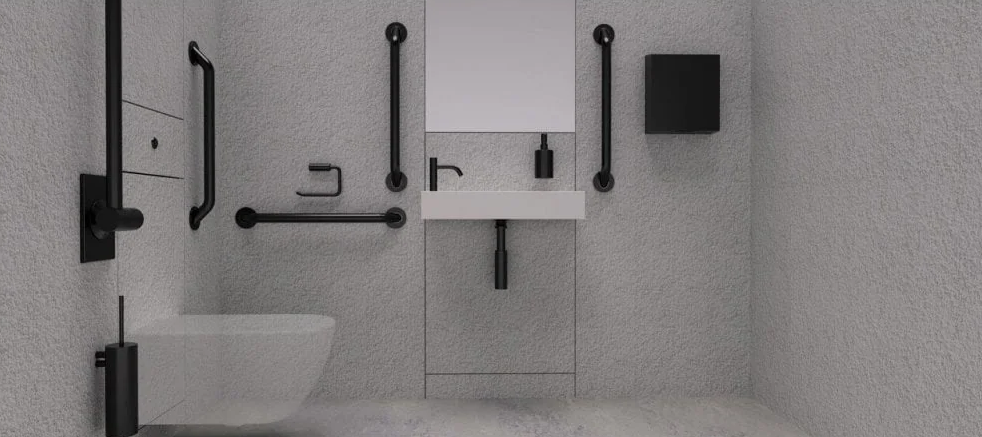
It's worth a brief mention that grab rail compliance goes beyond length and positioning. Rails need sufficient light reflectance value (LRV) contrast against the surrounding wall and floor finishes and RNIB guidance on colour and contrast confirms the widely used benchmark of at least 30 points difference, so rails are clearly visible to anyone with a visual impairment. This detail catches out installations that otherwise tick every dimensional box and Intelligent Hand Dryers' own designing bathrooms to accommodate grab rails covers it in more depth. Clear, contrasting washroom signage plays a similar role, helping visually impaired visitors identify accessible facilities in the first place.
What the Ten-Year Exemption Covers
For facilities managers, this means grab rail condition and coverage should sit on the same ongoing checklist as fire safety, not treated as a one-off consideration during an initial fit-out and then forgotten. It's worth being precise about what the ten-year exemption covered earlier protects, since it's narrower than it first sounds.
- It protects a properly installed feature from being forced to change simply because guidance or expectations move on, it doesn't mean the rail can be damaged, loose, or worn and still count as compliant
- It applies feature by feature and project by project, not as a single building-wide timer covering everything installed around the same time
- It only covers that one specific physical feature under the reasonable adjustment duty, not the business's wider Equality Act obligations as a whole
Building owners undertaking refurbishment work carry Doc M responsibility directly during that project, which is exactly why getting the installation right the first time matters so much. If you're unsure where responsibility sits on a specific project, Intelligent Hand Dryers' team can help clarify what's required before work begins, rather than after an inspection flags a gap.
What Happens If a Washroom Isn't Doc M Compliant?
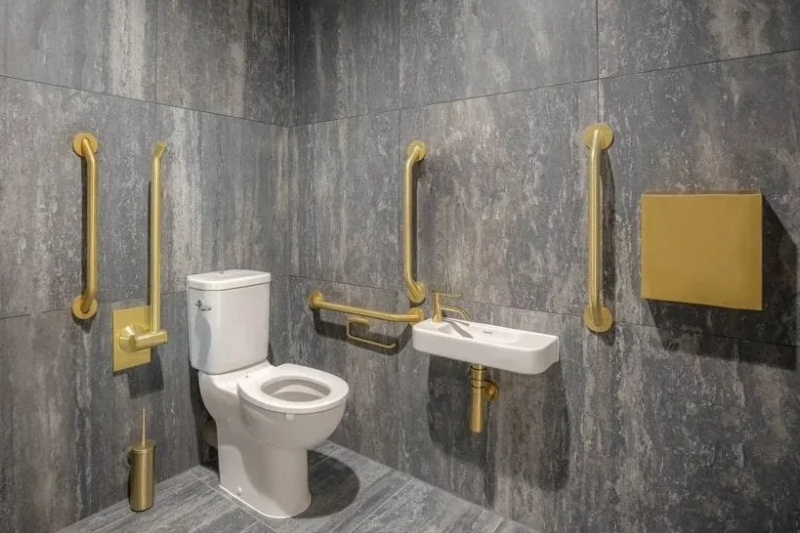
Skipping or under-specifying grab rails rarely results in an immediate fine tied specifically to the rail itself. The real exposure sits with the Equality Act. If a disabled person is placed at a substantial disadvantage because a washroom lacks proper support rails, that can constitute unlawful discrimination and the Equality and Human Rights Commission has real enforcement powers to investigate cases like this, with the business or organisation responsible for the premises carrying the liability. Beyond the legal risk, there's the reputational cost of a business that's visibly failed to accommodate disabled customers, staff, or visitors, plus the practical issue of insurers and inspectors flagging non-compliant facilities during audits.
How to Make Your Washroom Doc M Compliant
For most businesses, the simplest route to full compliance is a Doc M pack, which bundles the correct grab rails, WC, basin and taps into a single Doc M accredited solution rather than requiring each element to be specified and checked separately. The Bobrick Doc M Pack Grab Rail for ambulant washrooms is a good example of a specific, accredited product built for exactly the ambulant scenario covered above. All of our Doc M shower packs handle that side of compliance in the same accredited way.
For businesses handling grab rails as a standalone purchase, whether that's replacing worn fittings or adding them to an existing washroom, the full grab rails range covers the lengths, finishes and mounting types needed across all three situations covered here. If you're planning a wider accessible washroom refurbishment, it's also worth looking at compatible shower seats and quiet hand dryers, since accessible washrooms typically need to satisfy several compliance requirements at once, not just the grab rail specification in isolation.
Grab rails are a legal requirement in three clear situations: any wheelchair-accessible unisex washroom, any same-sex washroom (which needs its own ambulant provision regardless of what else exists in the building) and any refurbishment or change of use that brings an older washroom under current Doc M regulations. Getting the specification right the first time matters, both for immediate compliance and for the ten-year window that follows once a Doc M compliant feature is properly installed.
If you're working through a washroom refurbishment and want to make sure grab rails are correctly specified from the outset, our Doc M packs and standalone grab rails range cover every situation outlined above. Browse the wider Intelligent Thinking blog for more washroom compliance guidance, or get in touch with the team directly if you'd like help confirming exactly which Doc M requirements apply to your specific building and layout.

01143540047
02033270448