Specifying a shower for a commercial washroom means understanding what you're buying, since most commercial showers come as a complete kit or panel rather than a head, control and valve bought separately. Knowing what's inside that kit, the control mechanism and the valve behind it, determines how the shower performs day to day, how much water it uses and in some settings, whether it's even legal to install. Here's what to look for.
What's Inside a Commercial Shower Kit?
A commercial shower kit typically bundles two or three components into a single purchase. Here's what each part does:
- Shower head delivers the water to the user
- Control mechanism decides how the flow starts, stops and how long it runs for
- Valve manages temperature and in many settings, safety
Most of the range, panels like the SECURITHERM and kits like the TEMPOSTOP, already combine the control and valve together and often the head too, so the buying decision usually comes down to which type of control and valve sits inside the kit rather than sourcing three parts individually.
Standalone heads do exist for situations where the control and valve are already in place, such as replacing a worn head without touching the panel behind it. Getting the control and valve type wrong within a kit is still a common mistake, though. A kit with the wrong control type can undermine water saving targets in a gym and one with the wrong valve can leave a healthcare setting non-compliant before it's even opened. It's also worth checking that any shower fitting connected to the mains supply carries WRAS approval, since UK water regulations place a legal duty on using compliant fittings regardless of setting.
Commercial Shower Heads Explained
Shower heads are the most straightforward part of the system, largely because there's less regulatory nuance involved. A standalone fixed head, such as the DELABIE TONIC JET fixed shower head, has no built-in control mechanism of its own. It simply delivers water once the valve or control upstream allows it through, which makes it a sensible choice for replacing a damaged head without needing to replace the wall-mounted panel or push-button unit behind it.
For a new installation, most buyers are better served by a complete kit, where the head is already matched to the control and valve inside it. The real decisions worth focusing on are the control mechanism and the valve, which is what the rest of this guide covers.
What Is a Time Flow Shower Valve?
A time flow shower valve is the classic push-button control found across gyms, schools and public leisure facilities and it's built into a number of the kits in this range. Press the button and water flows for a fixed duration before shutting off automatically, which is exactly the mechanism behind the DELABIE TEMPOSTOP time flow shower kit, running for around 30 seconds per press with the head, control and valve all included in one purchase.
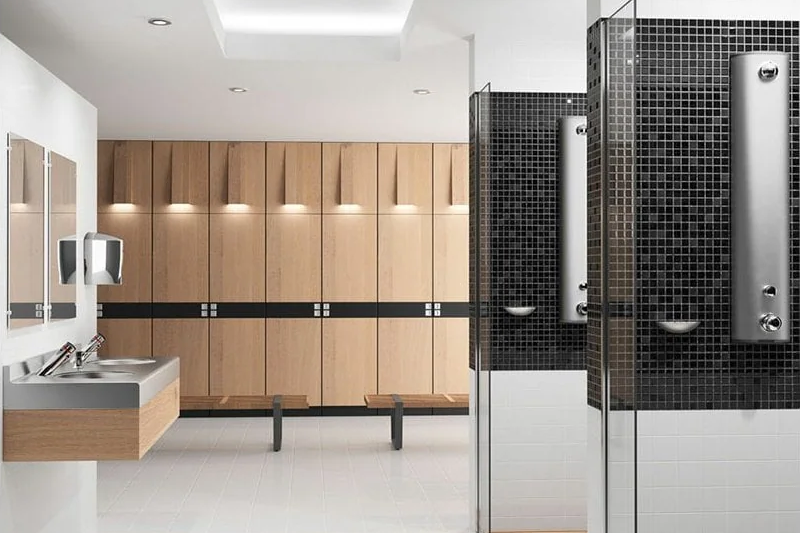
How long does a time flow shower run for is one of the more common questions buyers ask and the honest answer is it depends on the specific kit, with most commercial units adjustable somewhere between 15 and 40 seconds. This adjustability matters in high-footfall settings, since a shorter run time reduces water use across hundreds of daily uses without users needing to remember to turn anything off. The mechanical, self-closing nature of these valves also makes them properly difficult to leave running by accident, which is a real cost consideration for facilities managers watching water bills closely.
How Does a Thermostatic Shower Mixer Work?
A commercially installed thermostatic shower mixer works differently to a time-flow valve. Rather than controlling duration, it controls temperature, blending hot and cold water to maintain a consistent, safe output regardless of pressure fluctuations elsewhere in the building. This matters more than it might sound, since a sudden drop in cold water pressure on a standard mixer can send scalding water through an outlet with no warning.
The DELABIE SECURITHERM thermostatic time flow shower panel demonstrates how this works in practice, with 38°C and 41°C temperature limiters built into the panel alongside anti-scalding and anti-cold-shower protection. It's also suitable for Approved Document M compliant washrooms, which matters directly for accessible washroom compliance covered further down.
Combined Thermostatic and Time Flow Controls
Some kits need both temperature safety and automatic shut-off in a single panel, which is where combined units come in. The DELABIE SECURITHERM soft touch time flow shower panel pairs thermostatic control with a soft-touch time-flow trigger, giving both water saving and anti-scald protection from one fitting rather than requiring two separate panels to be specified and installed correctly together.
What Is an Electronic Sensor Shower Kit?
For settings where hygiene and hands-free operation matter more than mechanical simplicity, an electronic sensor shower kit removes the physical trigger entirely. The DELABIE TEMPOMATIC cross wall electronic shower kit uses sensor activation, similar in principle to how sensor taps work, starting the water automatically once movement is detected and stopping it once the user steps away.
This has real advantages beyond hygiene. There's nothing for users to touch, which suits changing rooms and healthcare settings where cross-contamination is a genuine concern and it removes the risk of a control being left running or damaged through repeated physical use. Similar trade-offs apply here to those explored in the advantages and disadvantages of sensor taps, since most of the same considerations transfer directly to electronic shower kits.
What's the Difference Between TMV2 and TMV3?
What Is a TMV?
A thermostatic mixing valve, or TMV, blends hot and cold water to deliver a consistent, safe temperature at the shower head and shuts off if pressure drops suddenly to prevent scalding. It's classified into two grades, TMV2 and TMV3, depending on where it's used.
What Is a TMV2?
TMV2 valves are tested against British Standards BS EN 1111 and BS EN 1287 and are suitable for general commercial and domestic settings, including gyms, schools, offices and most public washrooms.
What Is a TMV3?
TMV3 valves are built and tested to a higher standard, the NHS D08 specification and are mandatory in healthcare environments such as hospitals and care homes. HSE guidance on managing legionella in hot and cold water systems confirms thermostatic mixing valves need to be fitted as close as possible to outlets wherever a scald risk is identified, which is exactly the role TMV3 valves play in higher-risk healthcare settings.
TMV2 vs TMV3, What's the Real Difference?
This is one of the most misunderstood distinctions in commercial washroom specification and getting it wrong has real compliance consequences. The core difference isn't that one is simply better than the other. TMV3 valves react faster to sudden pressure or temperature changes, which matters most where users may be more vulnerable, less able to react quickly to a scalding risk, or unable to move away from the water source unassisted. Choosing a kit with a TMV2 valve where TMV3 is required is a genuine compliance failure, not just a minor specification mismatch, so it's worth confirming exactly which standard a given site requires before ordering.
Doc M Shower Requirements Explained
Accessible showers carry their own specific requirements under Doc M and these go beyond simply fitting a grab rail. The core requirement is a thermostatically controlled valve with a maximum output temperature of 41°C, paired with an emergency pull-cord and appropriate seating and grab rail provision, with the full detail laid out in Doc M shower layouts, the essentials.
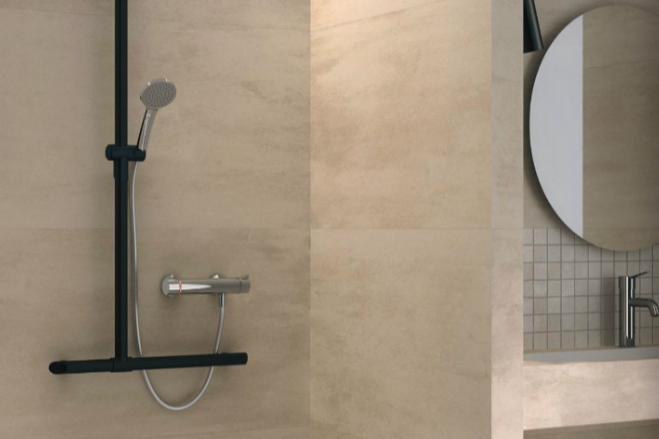
For anyone specifying a fully compliant accessible shower in one purchase, Doc M shower packs bundle the valve, head, thermostatic mixer, seat and grab rails together, removing the risk of getting one element right and another wrong when they're sourced separately. Beyond the shower itself, the wider Doc M packs range covers the rest of an accessible washroom and anyone working through the broader dimensional requirements will find the basics of Doc M layout worth reading alongside this.
Time Flow vs Thermostatic, Which Kit Is Better for a Commercial Washroom?
There's no single correct answer here, since the right choice depends heavily on the setting. Time-flow kits win on water and cost control, which is exactly why they dominate in gyms, schools and high-footfall leisure facilities where hundreds of showers happen daily and every second of unnecessary water use adds up.
Thermostatic kits win on comfort and consistency, which matters more in hotels, where guest experience is the priority and metering water use matters far less than it does in a school changing room.
Healthcare settings aren't really a choice at all, since TMV3 shower valve requirement rules make thermostatic control mandatory regardless of preference. For everyone else, the honest framing is that time-flow suits high-volume, cost-conscious environments, while thermostatic suits settings where the priority is a consistently comfortable shower experience for a smaller number of daily users.
Which Shower Kit Suits Which Sector?
Different sectors tend to gravitate toward different combinations of control and valve, largely driven by how the space is used day to day. Here's a quick guide to what typically works best:
- Gyms and leisure centres generally suit time-flow, TMV2-rated kits with a durable, vandal-resistant head, since high daily usage makes water control and durability the priority
- Schools follow a similar pattern to gyms, often with concealed valves to reduce tampering risk in unsupervised changing areas
- Healthcare settings require TMV3-rated thermostatic kits without exception, alongside Doc M compliant fittings wherever the shower serves patients or residents with mobility needs
- Hotels typically favour thermostatic or combined thermostatic time-flow panels, prioritising guest comfort and a premium feel over strict water metering
Matching the kit to how a space is really used, rather than defaulting to whatever's cheapest or most familiar, tends to produce far better results across the lifespan of the installation.
The distinctions covered here, time-flow versus thermostatic, TMV2 versus TMV3, concealed versus exposed, all shape how a shower performs day to day and whether it's compliant with the site it's going into.
If you're weighing up options for a gym, school, hotel, or healthcare setting, the full commercial showers range covers every combination above, alongside compatible grab rails and shower seats for accessible builds. Get in touch with the team today if you'd like a hand confirming which standard your site needs before you order.

01143540047
02033270448