For most people, buying a hand dryer usually comes down to comparing a few numbers on a spec sheet and wattage is normally the first one people look at. It feels like the obvious measure of power, so the dryer with the bigger number seems like the safer bet but wattage on its own can be misleading. A 1000W dryer can end up costing less to run than a 500W one and a slower dryer can sometimes work out cheaper over a year than a faster model sitting right next to it on the shelf. To understand why, it helps to start with what wattage measures and where that measurement falls short.
How do four hand dryers compare on the numbers that matter?
| Model | Rated Power | Dry time | Energy per dry | Noise level | Cost per 1000 dries |
| Viska |
0.12 kW - 1 kW |
10-12s |
0.40 - 2.78 Wh |
65 dBA |
£0.08 |
| Jet Towel Wave u02 |
0.49 kW - 0.98 kW |
8-14s |
1.83 - 2.67 Wh |
59 dBA |
£0.37 |
| Airblade V HU02 |
1 kW |
12s |
3.33 Wh |
71dBA | £0.67 |
| Conventional warm air dryer | 2.5kW | 40s | 27.78 Wh | ~80-85 dBA | £5.56 |
The table above lines up four dryers against the numbers that decide running costs and it's worth keeping in mind as a reference point through the rest of this piece, since the sections below explain what each column means rather than repeating every figure.
1. Hand dryer wattage
Why is hand dryer wattage the most misleading number on the spec sheet?
Wattage is simply the rate at which a dryer uses electricity while it's running. A 1000W dryer pulls twice as much power at any given moment as a 500W one and on its own that sounds like a straightforward way to judge running costs. The catch is that wattage only measures power draw, not how long that draw lasts and a hand dryer's total energy use for one dry depends on both.
This is why a powerful high speed hand dryer rated at 1000W isn't automatically more expensive to run than a 500W model. If the 1000W dryer finishes the job in half the time, the two could end up using a similar amount of energy per dry. Wattage tells you how hard the motor is working, not how much a dryer costs to run, which is why it's the number that gets misread most often.
Does a higher wattage always mean a faster hand dryer?
No, a higher wattage doesn't automatically mean a faster hand dryer, because dry time comes down to motor design and airflow efficiency as much as raw power. Take the Dyson Airblade V HU02 (1kW) and the Jet Towel Smart Wave u02 (0.98kW). The Airblade V has the higher power rating, but the Jet Towel Smart dries hands faster, at 8 seconds against the Elite's 12. A higher wattage suggests more power, yet here the lower-powered dryer wins on speed.
The relationship between wattage and speed comes down to motor design and airflow efficiency rather than raw power alone. A dryer with a narrower, faster-moving jet of air can shift water off the hands more effectively than one relying on brute wattage. Chasing the highest wattage figure on a spec sheet and expecting it to translate into speed, is one of the most common mistakes facilities managers make when comparing units.
2. Hand dryer dry time
Why does dry time matter as much as the power rating?
Dry time is the other half of the equation and it's just as easy to misjudge on its own. A fast dry time sounds like a good thing and usually is, but only when it's weighed against the power needed to achieve it. As the table above shows, the fastest dryer isn't always the highest-powered one and neither number alone tells you which dryer is more efficient.
Where dry time matters most is in high traffic locations, where a few extra seconds per person adds up across hundreds of daily uses and can create queues at busy times. In a quiet office washroom, an extra five or ten seconds barely registers. Matching dry time to how a hands-in hand dryer or wall-mounted unit will be used matters more than chasing the fastest number on the spec sheet.
3. Energy per dry
What is ‘energy per dry’ and why does it matter more than watts alone?
Energy per dry, usually shown in watt-hours (Wh), is what you get when you combine wattage and dry time into one figure. It's the number that answers the question people are really trying to ask when they look at wattage alone.
A conventional warm-air hand dryer typically uses around 27.78 Wh per dry, based on a 2500W rating and a 40 second dry time. Look at the other three rows in the table above and the gap is striking, with the most efficient model using a fraction of that figure despite a much lower wattage than the conventional benchmark. Once the numbers are lined up like this, it's clear why watts alone don't tell you much.
The government's own benchmark for efficient equipment backs this up. To qualify for the Energy Technology List, high speed hand dryers must use less than 6.9 kWh of electricity per 1,000 standard drying cycles. That works out to under 6.9 Wh per dry, a threshold Dryflow Hand Dryers has met with several models in its range. It's worth knowing that the tax relief originally tied to that scheme ended back in 2020. The efficiency threshold itself is still a useful benchmark for what counts as low energy, though. Anything comfortably under that figure, like these low energy hand dryers, sits at the better end of what's currently available.
4. Noise level
How loud is too loud for a commercial hand dryer?
Noise is measured in decibels, or dB(A) and it's the number that matters most in schools, libraries, small offices or anywhere people are trying to work or concentrate nearby. The table above shows a real spread between models, even before accounting for the fact that hand dryers are often louder in real environments than the test data shows. For comparison, ordinary conversation sits around 60 dB and the Health and Safety Executive's noise regulations set 85 dB(A) as the level where hearing protection and hearing protection zones become a legal requirement for daily workplace exposure, so even the loudest commercial dryers sit well below that, though the perceived loudness in a small tiled washroom is often higher than the manufacturer's figure suggests.
A few extra decibels rarely matter in a busy shopping centre washroom, but they're worth checking closely for anywhere sound sensitivity is a real consideration. The quiet hand dryers range is built specifically around this, trading a little speed for a noticeably calmer washroom environment.
5. Running cost
What does a hand dryer cost to run per 1000 dries?
This is the number that turns everything else into pounds and pence and it's where the gap between models becomes hard to ignore. For an office of 100 people using the washroom four times a day, running a Dyson Airblade V HU02 costs around £69 a year in electricity. A Mitsubishi Jet Towel does the same job for around £38 a year - almost half the cost. Paper towels covering that same usage come in at roughly £727 a year, according to Intelligent Hand Dryers' cost-effectiveness analysis, which works out at over ten times what the Airblade costs and almost twenty times what the Jet Towel costs.
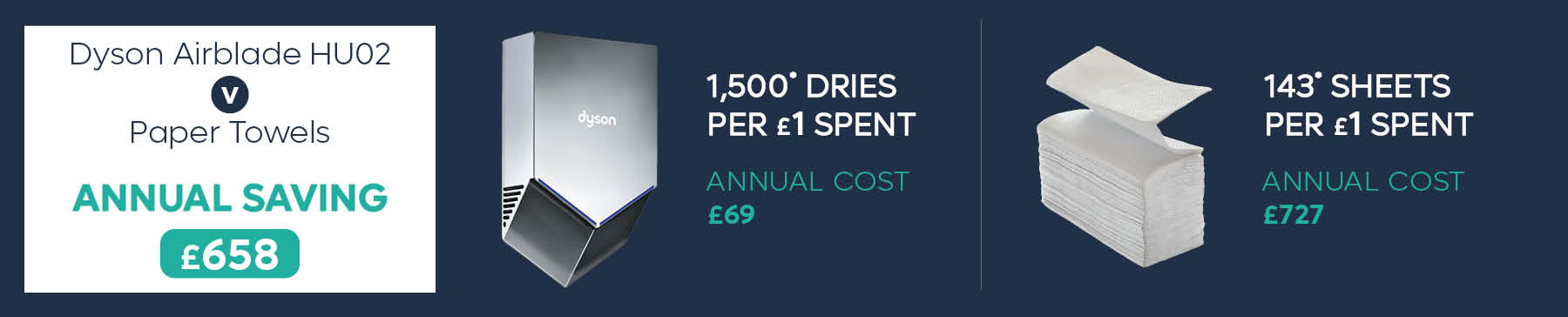
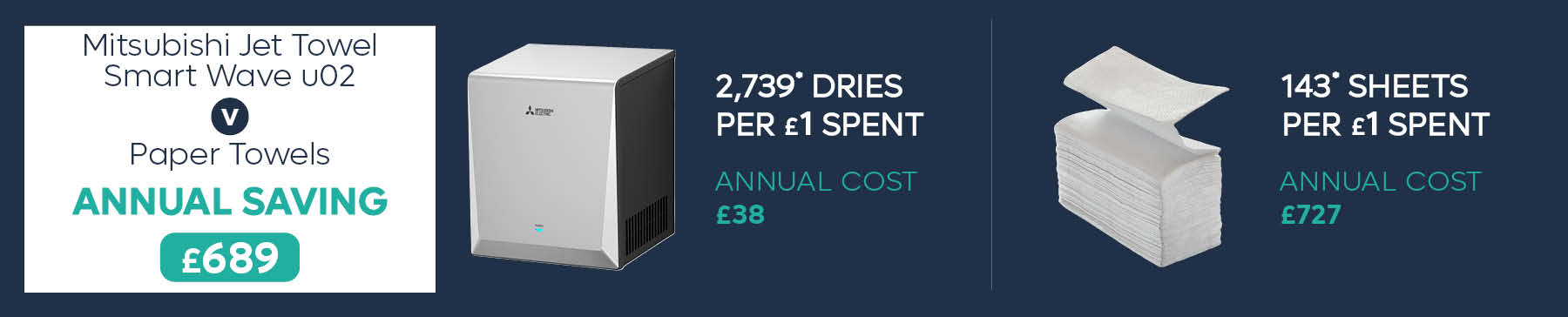
Per 1,000 dries, that same pattern holds: paper towels sit at around £17.98, against £0.67 for the Airblade and £0.37 for the Jet Towel once electricity is priced at a typical business rate of 20p per kWh. Government energy price statistics show non-domestic rates vary by region, supplier and consumption band, so it's worth checking your own tariff before assuming these figures apply exactly to your site, but the scale of the gap between hand dryers and paper towels holds regardless of the exact rate you're on.
Does the environmental footprint of paper towels change the numbers?
The running cost gap is only part of the picture, since paper towels carry a manufacturing footprint that never shows up on a price tag. Producing a ton of paper towels uses thousands of kilowatt-hours of electricity and thousands of gallons of water and generates dozens of pounds of air pollutants, according to environmental data from the City of San Diego's recycling programme, a cost that just moves upstream rather than disappearing when a towel is binned.
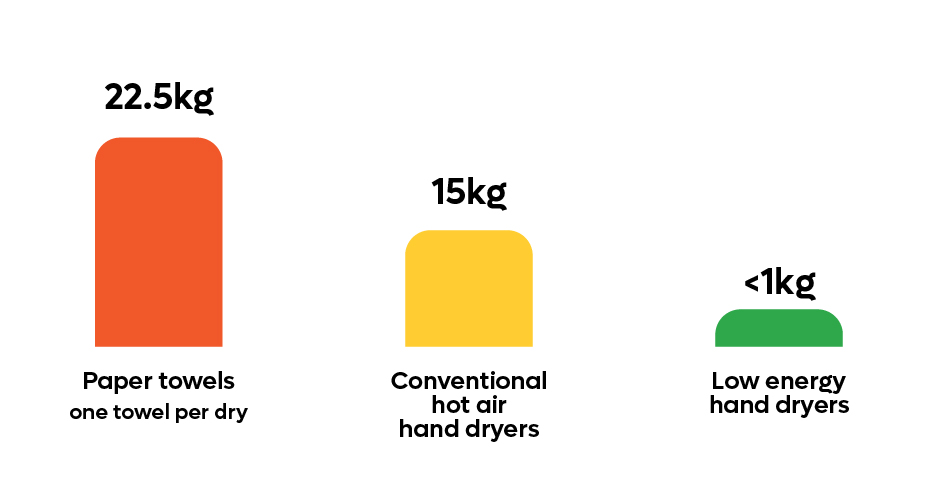
Hand dryers have their own footprint too, mostly from the electricity they use, but the numbers still favour the dryer once footfall is high enough: a conventional model produces around 15 kg of CO2 per 1,000 dries against roughly 22.5 kg for the same number of paper towel uses and that gap widens further with a properly low energy dryer. A few figures worth knowing when weighing this up:
Paper towel manufacturing produces several thousand kWh of energy and several thousand gallons of water per ton produced, before a single towel is used This won't be the deciding factor for every washroom, but it's a useful tiebreaker when two dryers score similarly on cost and speed.
How do you compare two hand dryers properly?
Once you've got all five numbers, comparing two hand dryers stops being a guessing game. A useful checklist to run through when reading any spec sheet:
- Rated power (W or kW): how much electricity the motor draws while running
- Dry time (seconds): how long it takes to dry a pair of hands
- Energy per dry (Wh): the figure that combines the two above into something comparable
- Noise level (dB(A)): relevant wherever quiet operation matters
- Running cost (per 1,000 dries): what all of the above means in real terms
None of these numbers tells the full story on its own, but together they explain why a top-rated efficient hand dryer with a modest wattage can beat a flashier, more powerful model on running costs and why the best hand dryers on the market tend to score well across several of these figures rather than dominating on just one.
Wattage was never a bad number to look at, it's just an incomplete one. Once it's paired with dry time to work out energy per dry and weighed against noise and running cost, the spec sheet starts to tell you something useful about which dryer suits your washroom rather than which one merely sounds the most powerful.
If you'd like help comparing specific models against your own washroom's footfall and noise requirements, the hand dryer selection guide takes those five numbers and matches them to your space, or you can call 0114 3540047 to talk it through with the team directly.

01143540047
02033270448